
eSIM in Cambodia: Coverage, Setup & How Much Data You Need
How eSIM Works in Cambodia
Most people come to Cambodia for Angkor Wat and leave having discovered a country that is much more than that. Siem Reap for the temples, Phnom Penh for the history and riverfront, Kampot for the slow south, and the beaches of Koh Rong for the coast. Mobile data in Siem Reap works from the moment you land, with Phnom Penh, Sihanoukville, and Kampot all on the same plan. Get an eSIM for Cambodia from €4.33 and arrive connected from the first moment without hunting for a SIM card.

Photo by Serg Alesenko on Pexels
How much data do you need in Cambodia?
10-day plans · classic holiday. Instant QR delivery, no SIM swap.
Why Use an eSIM in Cambodia?
- Instant activation — no physical SIM card needed
- Works on most modern iPhones and Android devices
- Coverage across Cambodia, including Siem Reap, Phnom Penh, Sihanoukville, and tourist areas
- No roaming fees or long-term contracts
Cambodia's local SIM situation is relatively accessible — SIMs from Smart, Cellcard, and Metfone are available cheaply at the airport and in town shops. But they require your passport, and the process adds time to your first day. More practically: Cambodia is a largely cash and informal economy, and digital booking apps for tuk-tuks and buses depend on data to function. PassApp is the main ride app in Phnom Penh and Siem Reap. Without data, you are back to street-side bargaining in the heat. An eSIM lets you avoid roaming charges in Cambodia and step off the plane with your transport already ordered.
Cambodia's mobile coverage has improved dramatically in recent years, but the country's infrastructure outside the main cities is still developing. The road between Phnom Penh and Siem Reap — a popular 6-hour bus route — has stretches with limited signal. The southern coast between Sihanoukville and Kampot is similar. Having a reliable eSIM means your data reconnects automatically whenever coverage returns, without needing to manually toggle settings or troubleshoot a local SIM that may have deactivated in a no-signal area.
Coverage and Mobile Networks in Cambodia
Cambodia's mobile infrastructure has improved significantly, with 4G LTE available across the main cities and tourist areas through Smart and Cellcard.
- Siem Reap and the Angkor temple complex — mobile data in Siem Reap is reliable throughout the town, Pub Street, and across the Angkor Archaeological Park. Siem Reap International Airport (REP) has 4G coverage from the moment you land. The temples themselves — Angkor Wat, Bayon, Ta Prohm, Banteay Srei — all have usable signal.
- Phnom Penh and the central region — mobile data in Phnom Penh covers the riverfront, BKK1, Toul Tom Poung (Russian Market), and the full urban area. Phnom Penh International Airport (PNH) has coverage throughout.
- Sihanoukville and the southern coast — the main town and beach areas have 4G. Otres Beach and the main resort strip are covered.
- Kampot and Kep — both towns have solid 4G coverage along the waterfront and main areas.
- Koh Rong and Koh Rong Sanloem (main beach areas) — patchy but improving coverage, primarily in the main village and pier zones.
- Battambang and the northwest — the city and main tourist areas including the Bamboo Train site have coverage.
Cambodia's mobile network is dominated by Smart Axiata (backed by Axiata/Malaysia) and Cellcard (CamGSM). Smart has the better 4G LTE coverage across the country, especially outside the main cities. Metfone (Viettel's Cambodian subsidiary) is the third option. Coverage in Phnom Penh and Siem Reap is reliably good — both cities have consistent 4G across all tourist areas. Between cities, coverage follows the main national roads but can drop in less-developed rural areas. Cambodia's overall mobile infrastructure is improving rapidly but is not yet at the level of Thailand, Vietnam, or Malaysia. For the main tourist circuit — Siem Reap, Phnom Penh, the southern coast — coverage is reliable enough for maps, messaging, and ride-hailing apps.

Photo by K on Pexels
City Guide: Using Mobile Data in Cambodia's Top Destinations
Siem Reap
Siem Reap is the base for Angkor Wat, and mobile data in Siem Reap is genuinely useful inside the temple complex. The Angkor Archaeological Park covers over 400 square kilometers, and the main temples — Angkor Wat, Bayon, Ta Prohm, Preah Khan, Banteay Srei — are spread across a wide area. Google Maps helps with the distances between temples (many tourists underestimate how far Banteay Srei is from the main circuit), and having data means you can use PassApp to coordinate your tuk-tuk driver for pickup at each temple rather than waiting at a fixed meeting point. In town, Pub Street and the night market areas are walkable, but finding specific restaurants and booking sunrise tours for the next morning both need data.
Phnom Penh
Phnom Penh is Cambodia's capital and its most navigable city. Mobile data in Phnom Penh is essential for PassApp (the tuk-tuk booking app that saves you from negotiating in the heat), for finding the Killing Fields and Tuol Sleng Genocide Museum, and for navigating the Russian Market and Central Market areas. The riverfront district, Royal Palace, and Independence Monument are walkable but spread across several kilometers — Google Maps helps connect them efficiently. Internet for tourists in Phnom Penh is also useful for booking the bus or minivan to Siem Reap, which several companies run daily and can be compared and booked through apps.
Kampot
Kampot is Cambodia's southern gem — a riverside town known for pepper farms, its relaxed atmosphere, and the nearby Bokor National Park. Mobile data in Kampot is useful for finding the pepper farm tours, booking boat rides on the river, and navigating to the salt fields and Kep's crab market (about 30 minutes from Kampot). Kampot does not have a ride app presence like Phnom Penh, so Google Maps and WhatsApp for coordinating with your guesthouse or tuk-tuk driver are the main data needs.
Koh Rong
Koh Rong is Cambodia's main beach island, reached by ferry from Sihanoukville. Mobile data on Koh Rong is limited to the main pier and village areas — Koh Touch village on Koh Rong and Saracen Bay on Koh Rong Sanloem have basic 4G coverage. The interior of the islands and the more remote beaches are effectively offline. Use your data in the main areas to book return ferries and coordinate with your accommodation.
Battambang
Battambang is Cambodia's second city and increasingly popular with travelers looking beyond the standard Siem Reap-Phnom Penh route. Mobile data in Battambang is useful for finding the Phare Cambodian Circus (booking tickets is recommended), navigating to the Bamboo Train, and exploring the colonial-era architecture downtown. Battambang is also the starting point for boat trips to Siem Reap through Tonle Sap Lake — a scenic but long journey that benefits from advance booking through apps.
How Does a Cambodia eSIM Work?
- Choose your plan — pick the data and duration that fits your trip to Cambodia
- Receive your eSIM instantly — a QR code is sent to your email right after purchase
- Install and connect — scan the QR code, follow the steps on your phone, and you are ready to go when you land
eSIM vs Local SIM Card in Cambodia
You could buy a local SIM card when you arrive in Cambodia — but here is what that actually looks like:
- Local SIM: A prepaid SIM card in Cambodia for tourists costs around $2-3 with a starter data package. But they require your passport, and airport counters are not always open or well-stocked outside peak hours. Phnom Penh International Airport and Siem Reap International both have options, but if you arrive at an off-peak time, you may be directed to a small airport shop with limited stock and unclear pricing. Cambodia also uses physical top-up cards for adding data, which requires finding a convenience store every time you run out. The top-up card system uses scratch-off codes that you enter manually — a process that can be confusing with Khmer-language instructions.
- eSIM: Set it up on your phone before you fly. Land in Siem Reap or Phnom Penh, turn on your data, done. No store, no paperwork, no wasted time.
eSIM Plans for Cambodia
Plans start at €4.33 for 1 GB. Choose from 1 GB to unlimited data, with validity from 5 to 30 days. All plans include hotspot sharing so you can connect your laptop or tablet too.
View all Cambodia eSIM plans →
FAQs — eSIM Cambodia
Does eSIM work in Cambodia?
Yes. Cambodia has 4G LTE coverage through Smart Axiata, Cellcard, and Metfone. Coverage is reliable in Siem Reap, Phnom Penh, and along the main tourist routes. More remote areas and outer islands have limited coverage, but all main destinations are well served.
Can tourists use an eSIM in Cambodia?
Yes. No Cambodian ID or local registration required. You buy online, receive a QR code, scan it on your phone, and you are connected when you land. None of the local SIM passport registration steps apply.
When should I activate my Cambodia eSIM?
Install the eSIM before you board your flight — the installation step needs a WiFi connection. Your data activates automatically when you land and connect to a Cambodian carrier. Nothing to do at the airport.
Which devices support eSIM?
iPhone XR and newer, Samsung Galaxy S20 and newer, Google Pixel 3 and newer, and most recent iPad models. Check your phone settings under Mobile Data or Carrier to confirm eSIM support before purchasing.
Can I keep my regular phone number while using an eSIM?
Yes. Your physical SIM and home number remain fully active for calls and texts. The eSIM handles your data on a separate line. Both work at the same time.
Does the Cambodia eSIM work at Angkor Wat?
Yes. The Angkor Archaeological Park around Siem Reap has good 4G coverage throughout. Angkor Wat, Bayon, Ta Prohm, and the surrounding temples all have usable signal. Given that the complex covers over 400 square kilometres, having a working data connection for Google Maps is genuinely useful — the park is large enough to get disoriented in, and the satellite map view helps with temple-to-temple distances and tuk-tuk pickup points.
Can I use the eSIM on Koh Rong?
Koh Rong and Koh Rong Sanloem have patchy but improving coverage, particularly in the main beach and pier areas. The main villages on each island — Koh Touch on Koh Rong, Saracen Bay on Koh Rong Sanloem — have usable LTE. More remote beaches and the island interiors are effectively offline. For guesthouse bookings, ferry schedules, and staying in touch from the main areas, coverage is sufficient. Expect to be genuinely offline in the less-developed parts of the islands.
Does the Cambodia eSIM work in Kampot and Kep?
Yes. Kampot and Kep both have solid 4G coverage. The southern coast area around Kep National Park is well covered in the main town and market areas. Kampot is increasingly popular with longer-stay travelers and has reliable mobile connectivity throughout.
How much data do I need for two weeks in Cambodia?
For two weeks — Siem Reap, Phnom Penh, and the coast — PassApp for tuk-tuks, Google Maps, WhatsApp, booking tours at Angkor — 5 GB is enough for most travelers. Keep in mind you will have limited connectivity on Koh Rong if that is part of your itinerary.
Can I use PassApp (the ride app) in Cambodia with the eSIM?
Yes. PassApp is the main tuk-tuk and ride app in Phnom Penh and Siem Reap. It works like Grab — you need a live data connection to book and track your driver. With your eSIM active from landing, you can book a tuk-tuk from the airport before you step outside.
Can I share Cambodia eSIM data as a hotspot?
Yes. All plans include hotspot tethering. Useful at smaller guesthouses in Kampot and on the islands where WiFi is limited or slow.
What happens if I run out of data in Cambodia?
You can purchase a top-up from your phone while still in Cambodia. A new QR code arrives by email and installs within minutes. No carrier store, no physical top-up card to hunt down — which makes a real difference in areas outside Phnom Penh and Siem Reap where commercial infrastructure is limited.
Does the eSIM work on the bus between Phnom Penh and Siem Reap?
Coverage along the national highway between Phnom Penh and Siem Reap (about 6 hours by bus) is intermittent. You will have signal through the towns along the route — Skuon, Kampong Thom — and lose it in the more rural stretches. For messaging, checking arrival times, and light browsing during the populated stretches, it works. Plan to be partially offline during the journey.
Can I use Grab in Cambodia?
Grab does not operate in Cambodia. PassApp is the local equivalent and is widely used in Phnom Penh and Siem Reap. In Kampot, Sihanoukville, and the coast, transport is more informal — you will negotiate with tuk-tuk drivers directly or arrange through your guesthouse. PassApp needs data, and your eSIM provides it.
How does Cambodia's mobile coverage compare to Thailand and Vietnam?
Cambodia's coverage is good in the main cities but noticeably weaker in rural areas compared to Thailand and Vietnam. Between cities and on secondary roads, coverage drops more frequently. The main tourist destinations — Siem Reap, Phnom Penh, Kampot — are well covered. If you are traveling off the main routes, expect less consistent signal than you would get in neighboring countries.
Does the eSIM work in Battambang?
Yes. Battambang city has good 4G coverage. The main attractions — the Bamboo Train, Phare Circus, and the surrounding countryside temples — are covered in the main areas. Battambang is less touristy than Siem Reap but has a growing traveler scene and reliable mobile connectivity in town.
How much data does a day exploring Angkor Wat use?
A full day at the Angkor temples — Google Maps between temples, messaging your tuk-tuk driver, taking and sharing photos, checking which temples to prioritize — uses about 200-400 MB. The complex is large and you will be checking distances and routes frequently. A sunrise visit to Angkor Wat followed by the main circuit (Bayon, Ta Prohm, Preah Khan) is a full day of moderate data usage. Budget accordingly across your trip.
Can I use the eSIM to coordinate tuk-tuk drivers at Angkor?
Yes. Most Angkor tuk-tuk drivers now use WhatsApp, Facebook Messenger, or PassApp to coordinate with tourists. Having data means you can message your driver when you are ready for pickup at each temple, rather than agreeing on fixed times and waiting. This flexibility makes the temple-hopping experience much more efficient — you spend your time exploring rather than watching the clock.
Does Cambodia use the US dollar?
Yes — Cambodia has a dual-currency economy where US dollars and Cambodian riel are used interchangeably. ATMs dispense US dollars, and most tourist-facing businesses price in USD. Having data is useful for checking exchange rates and finding ATM locations through Google Maps, especially in smaller towns where ATMs are not always obvious.
How much data do I need for one week in Cambodia?
For one week covering Siem Reap and Phnom Penh — PassApp, Google Maps, WhatsApp, booking tours — 3 GB is enough for most travelers. If you are adding the southern coast or spending more time on social media and streaming, go for 5 GB.
Do I need a VPN with my eSIM in Cambodia?
No. Cambodia does not block Google, WhatsApp, Instagram, Gmail, or other Western services. All your usual apps work normally without restrictions.
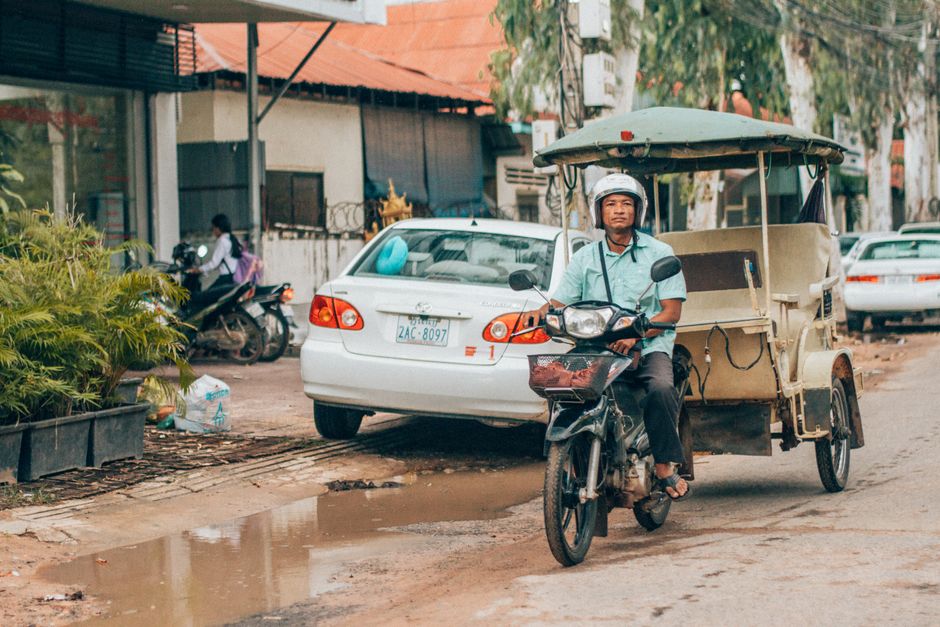
Photo by Humphrey Muleba on Pexels
Get Your Cambodia eSIM Today
Set up before you fly. Land in Siem Reap and you are online.
Related Reading
Last updated
Are you a hotel owner in Cambodia?
Earn commission by offering eSIMs to your guests. No setup cost, no hardware.
Learn about the Hotel Partner Program →